
Introduction To Claude AI
Learn specifically about Claude — who made it, why it was created, what makes it different from other AI tools, and why it has become one of the most trusted AI assistants in the world.
Created by
vSkul Teacher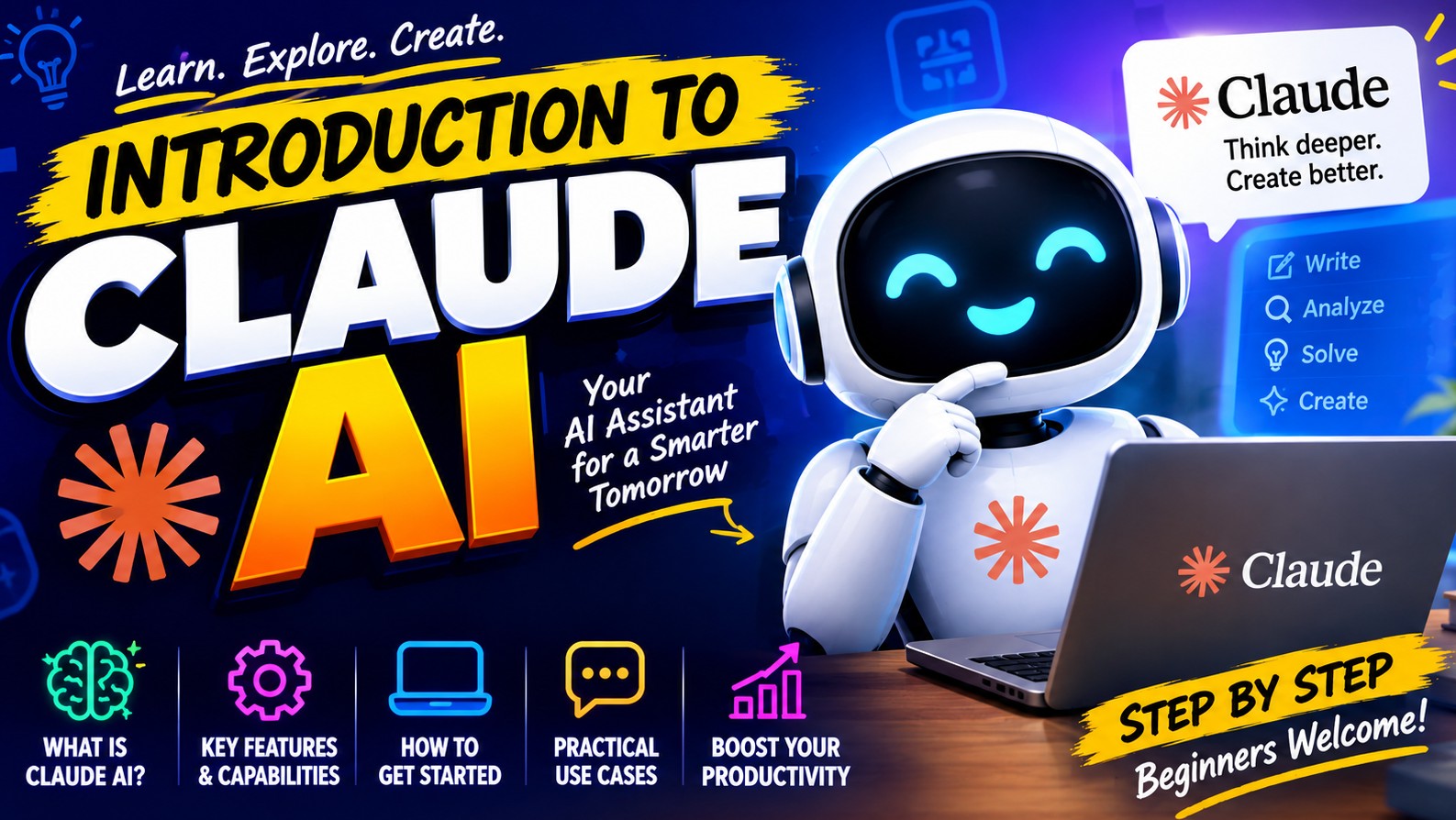
This course includes:
- 📹 4 video lessons
- ⏱ 2h 33m on-demand video
- 📱 Mobile & desktop access
- 🎓 Certificate of completion
- ♾️ Lifetime access
vSkul Teacher
B.Sc Mathematics, M.Ed Educational Technology
Professional teacher with more than 10 years of teaching experience.
Course Curriculum
What is Artificial Intelligence? A Plain English Explanation
Artificial Intelligence is one of the most talked-about topics in the world today, yet most people have only a vague sense of what it actually means. This lesson clears that up completely.
At its simplest, Artificial Intelligence refers to computer systems that can perform tasks that normally require human intelligence — things like understanding language, recognizing patterns, making decisions, solving problems, and generating text or images. Unlike traditional computer programs that follow rigid, fixed rules, AI systems learn from large amounts of data and can handle situations they were not explicitly programmed for.
You interact with AI more often than you probably realize. When your phone's keyboard suggests the next word as you type, that is AI. When Gmail filters spam from your inbox, that is AI. When Google Maps estimates traffic and reroutes you, that is AI. When a bank's system flags an unusual transaction on your account, that is AI. These examples show that AI is not a futuristic concept — it is already deeply embedded in tools Nigerians use every day.
The type of AI we focus on in this course is called a Large Language Model (LLM). This is an AI system specifically designed to understand and generate human language — meaning it reads what you type, understands the meaning and context, and responds in clear, natural language. Claude is one of the most advanced large language models in the world.
Understanding this foundation helps you approach Claude with the right mental model — it is not a search engine, it is not a simple chatbot, and it is not magic. It is a very capable AI system trained on enormous amounts of human knowledge, designed to assist you with the kinds of language-based tasks that make up most professional work.
What is Claude AI? History, Creator, and Core Purpose
Claude AI was created by Anthropic, a company founded in 2021 by former members of OpenAI — including Dario Amodei and Daniela Amodei. Anthropic was built around a specific mission: to develop AI systems that are safe, reliable, and genuinely beneficial to people. This mission shapes everything about how Claude was designed.
Claude was first released to the public in March 2023, and since then has gone through multiple versions — each significantly more capable, safer, and more nuanced than the previous. Today, Claude is used by millions of people and thousands of businesses across the world — from solo entrepreneurs to Fortune 500 companies.
What makes Claude distinctive among AI tools is its emphasis on three qualities above all else: honesty, helpfulness, and harmlessness. Anthropic uses a training approach called Constitutional AI — where Claude is taught to evaluate and correct its own responses against a set of principles. This means Claude is more likely to tell you it does not know something rather than confidently making up an answer, more likely to present balanced perspectives on complex topics, and more likely to decline requests that could cause harm.
For Nigerian users specifically, Claude has several advantages worth understanding. It has strong knowledge of Nigerian law, government processes, business environment, and cultural context — much more than many other AI tools. It handles very long documents — you can paste an entire contract or annual report and Claude will process all of it. It writes in clear, professional English that is appropriate for business and official communication. And the free tier of Claude.ai is genuinely useful — not a crippled version that forces you to upgrade.
Understanding who made Claude and why they made it helps you trust it appropriately. Claude is not trying to sell you anything. It has no advertising agenda. It simply tries to give you the most honest, helpful answer it can.
Claude vs. ChatGPT vs. Other AI Tools — What Should You Use?
By now there are dozens of AI assistants available — Claude, ChatGPT, Gemini, Copilot, Grok, and more. The options can be confusing, and many people waste time switching between tools without understanding what makes each one suitable for different tasks.
ChatGPT is made by OpenAI and was the first major AI assistant to reach mass popularity, launching in November 2022. It is excellent for creative writing, coding, and general conversation. Its paid version (GPT-4) is very capable. However, ChatGPT has been noted for sometimes generating confident but incorrect information — a problem called hallucination — and its responses can sometimes be overly cautious or evasive.
Google Gemini (formerly called Bard) is integrated with Google's products, making it useful when you need information connected to Google Search, Gmail, or Google Docs. It has access to real-time internet information, which Claude does not by default.
Microsoft Copilot is integrated into Microsoft Office (Word, Excel, Outlook) and is excellent for users already in the Microsoft ecosystem who need AI assistance within those specific tools.
Claude's advantages over these alternatives come down to a few critical strengths. First, document handling — Claude can process and reason about very long documents far better than most alternatives. Second, instruction following — Claude is exceptionally good at following complex, multi-part instructions precisely. Third, nuanced writing — Claude produces more natural, professional, and contextually appropriate writing than most competitors. Fourth, honesty — Claude is more willing to say it does not know something rather than guess.
For Nigerian professionals in this course, we recommend starting with Claude because its strengths align directly with the most common Nigerian professional needs — document preparation, legal and business analysis, research, and formal writing. Once you are comfortable with Claude, experimenting with other tools for specific purposes becomes much easier.
24
Setting Up Your Claude Account — Step by Step
Lesson 4 Setting Up Your Claude Account — Step by Step
Level: Beginner
Short Description
A complete, step-by-step walkthrough for creating your Claude account and accessing all features of the free plan — on both desktop and mobile.
Full Description
Getting started with Claude is simpler than most people expect. There is no software to install on a computer, no complex configuration, and no payment required to begin. This lesson walks you through every step.
To access Claude on a computer or laptop, open any web browser — Chrome, Firefox, Edge, or Safari — and go to claude.ai. You will see a simple homepage with options to sign up or log in. Click "Sign Up" and choose how you want to create your account. You can register using your email address, or sign in directly with a Google or Apple account if you have one. If you use an email address, Claude will send you a verification link — check your inbox, click the link, and your account is created.
To access Claude on a mobile phone (which most Nigerians use as their primary device), go to the Google Play Store if you have an Android phone, or the Apple App Store if you have an iPhone. Search for "Claude AI" by Anthropic. Download and install the app. Open it, and sign in or create an account exactly as described above.
The free plan gives you access to Claude Sonnet, which is Anthropic's highly capable mid-tier model. It is more than sufficient for everything in this course. You will have daily message limits — meaning you can only send a certain number of messages per day before you need to wait for the limit to reset. In practice, most users rarely hit this limit for normal professional use. If you need to do very large volumes of work, the Claude Pro subscription costs approximately $20 per month and removes most limits.
One important thing to know: Claude operates in conversations. Each conversation is a fresh context — Claude does not automatically remember things from a previous conversation unless you tell it again. Think of each new conversation as starting fresh, while within a single conversation, Claude remembers everything you have said from the beginning.
What Students Will Learn
• Create a Claude account using email or Google sign-in
• Access Claude through both the web browser and the mobile app
• Understand the difference between the free plan and Claude Pro
• Know what the daily message limit means and how to manage it
• Understand how Claude's conversation memory works
• Navigate the basic interface including starting new conversations and continuing existing ones
Lesson Requirements
• A smartphone with internet access, or a computer with a web browser
• An email address or Google/Apple account for registration
• No technical knowledge required
• Approximately 5 minutes to complete the setup
Lesson Level: Beginner
Lesson 5 Your First Conversation with Claude — How to Talk to AI
Level: Beginner
Short Description
Learn the art of communicating effectively with Claude through your very first conversation — understanding how to phrase requests, give context, and get genuinely useful responses.
Full Description
Many people open Claude for the first time, type something vague, get a response that does not quite meet their needs, and conclude that AI is not that useful. This lesson prevents that experience entirely. The difference between a frustrating Claude experience and a transformative one is almost always in how you frame your request.
Claude is not a search engine where you type a few keywords. Claude is a knowledgeable, responsive assistant who works best when you communicate the way you would with an intelligent human colleague. That means providing context, being specific about what you need, and stating the format in which you want the answer.
The single most important improvement you can make to any Claude request is adding context about who you are and why you need the information. Compare these two requests: "How do I register a business?" versus "I am a 29-year-old woman in Kano who wants to register a catering business with a business name under the CAC. I have about ₦20,000 for fees. Walk me through the registration process step by step." The second request gives Claude everything it needs to provide specific, actionable, Nigeria-appropriate guidance rather than a generic international overview.
The second most impactful improvement is specifying the format. "Give me this as a numbered step-by-step guide" produces a completely different — and often more useful — response than the same request without format specification. Other useful format instructions include: "Write this as a professional email," "Summarise this in three bullet points," "Explain this as if I have no background in finance," or "Give me a table comparing these options."
In this lesson you will have your first real Claude conversation — asking for something specific to your actual professional life or business. This is not a practice exercise. By the end, you will have gotten genuine value from Claude for the first time.
What Students Will Learn
• Understand why context is the single most important element of a good Claude request
• Structure a request that includes who you are, what you need, and the format you want
• Compare weak and strong versions of the same request and explain the difference
• Have your first genuine, productive conversation with Claude on a real task
• Use follow-up questions to refine and deepen a Claude response
• Understand when to start a new conversation versus continuing an existing one
Lesson Requirements
• A created and working Claude account (from the previous lesson)
• One real task from your work or life that you want help with
• No technical knowledge required
• An open mind — some responses will surprise you
Lesson Level: Beginner
Lesson 6 The Art of Prompting — Getting the Best from Every Request
Level: Beginner
Short Description
Master the fundamental skill of prompt writing — the techniques that transform vague requests into precise, powerful instructions that unlock Claude's full capability.
Full Description
Prompting is the skill of communicating with an AI in a way that produces excellent results consistently. It is not a technical skill — it requires no coding or special language. It is a communication skill, and it is learnable in a single lesson.
The first technique is the Role Instruction. You can tell Claude to take on a specific professional role before answering your question. For example: "You are an experienced Nigerian business lawyer. Review the following contract clause and explain what it means and whether it is favourable to me as the buyer." By assigning Claude a role, you direct it to respond from a specific knowledge perspective rather than as a general assistant.
The second technique is the Output Specification. Always tell Claude what form you want the answer in. "Give me a table," "Write this as a WhatsApp message," "List the five most important points only," "Write this at a secondary school reading level" — these instructions shape the output dramatically.
The third technique is the Constraint. Tell Claude what NOT to include as well as what to include. "Do not use legal jargon — explain everything in plain language" or "Keep this under 300 words" or "Focus only on the situation in Nigeria — do not give me international comparisons" — these constraints prevent common frustrations where Claude gives you more, or different, information than you need.
The fourth technique is the Example. Show Claude the style or format you want by providing an example. "Write a professional email in the same tone as this one: [paste example]." Claude picks up on examples far more reliably than abstract descriptions of tone.
The fifth technique is the Step-by-Step Request. For any complex task, ask Claude to break it into steps or to think through the problem methodically before answering. "Think through this problem step by step before giving me your recommendation" produces more careful, accurate answers on complex questions.
In this lesson you will practice all five techniques on tasks relevant to your own work.
What Students Will Learn
• Apply the Role Instruction technique to direct Claude's knowledge perspective
• Use Output Specification to control the format of every response
• Write Constraints that prevent irrelevant or unwanted content
• Use Examples to communicate tone and style more effectively than descriptions
• Apply Step-by-Step requests to improve Claude's reasoning on complex questions
• Combine multiple techniques in a single, powerful prompt
Lesson Requirements
• A working Claude account and at least one completed conversation
• Completion of the previous lesson in this section
• No technical knowledge required
• A specific professional context — know what type of work you do
Lesson Level: Beginner
What You'll Learn
Requirements
About This Course
Claude AI was created by Anthropic, a company founded in 2021 by former members of OpenAI — including Dario Amodei and Daniela Amodei. Anthropic was built around a specific mission: to develop AI systems that are safe, reliable, and genuinely beneficial to people. This mission shapes everything about how Claude was designed.
Claude was first released to the public in March 2023, and since then has gone through multiple versions — each significantly more capable, safer, and more nuanced than the previous. Today, Claude is used by millions of people and thousands of businesses across the world — from solo entrepreneurs to Fortune 500 companies.
What makes Claude distinctive among AI tools is its emphasis on three qualities above all else: honesty, helpfulness, and harmlessness. Anthropic uses a training approach called Constitutional AI — where Claude is taught to evaluate and correct its own responses against a set of principles. This means Claude is more likely to tell you it does not know something rather than confidently making up an answer, more likely to present balanced perspectives on complex topics, and more likely to decline requests that could cause harm.
For Nigerian users specifically, Claude has several advantages worth understanding. It has strong knowledge of Nigerian law, government processes, business environment, and cultural context — much more than many other AI tools. It handles very long documents — you can paste an entire contract or annual report and Claude will process all of it. It writes in clear, professional English that is appropriate for business and official communication. And the free tier of Claude.ai is genuinely useful — not a crippled version that forces you to upgrade.
Understanding who made Claude and why they made it helps you trust it appropriately. Claude is not trying to sell you anything. It has no advertising agenda. It simply tries to give you the most honest, helpful answer it can.
Student Reviews
No reviews yet. Be the first to review this course!